The Lantern in Our Pockets
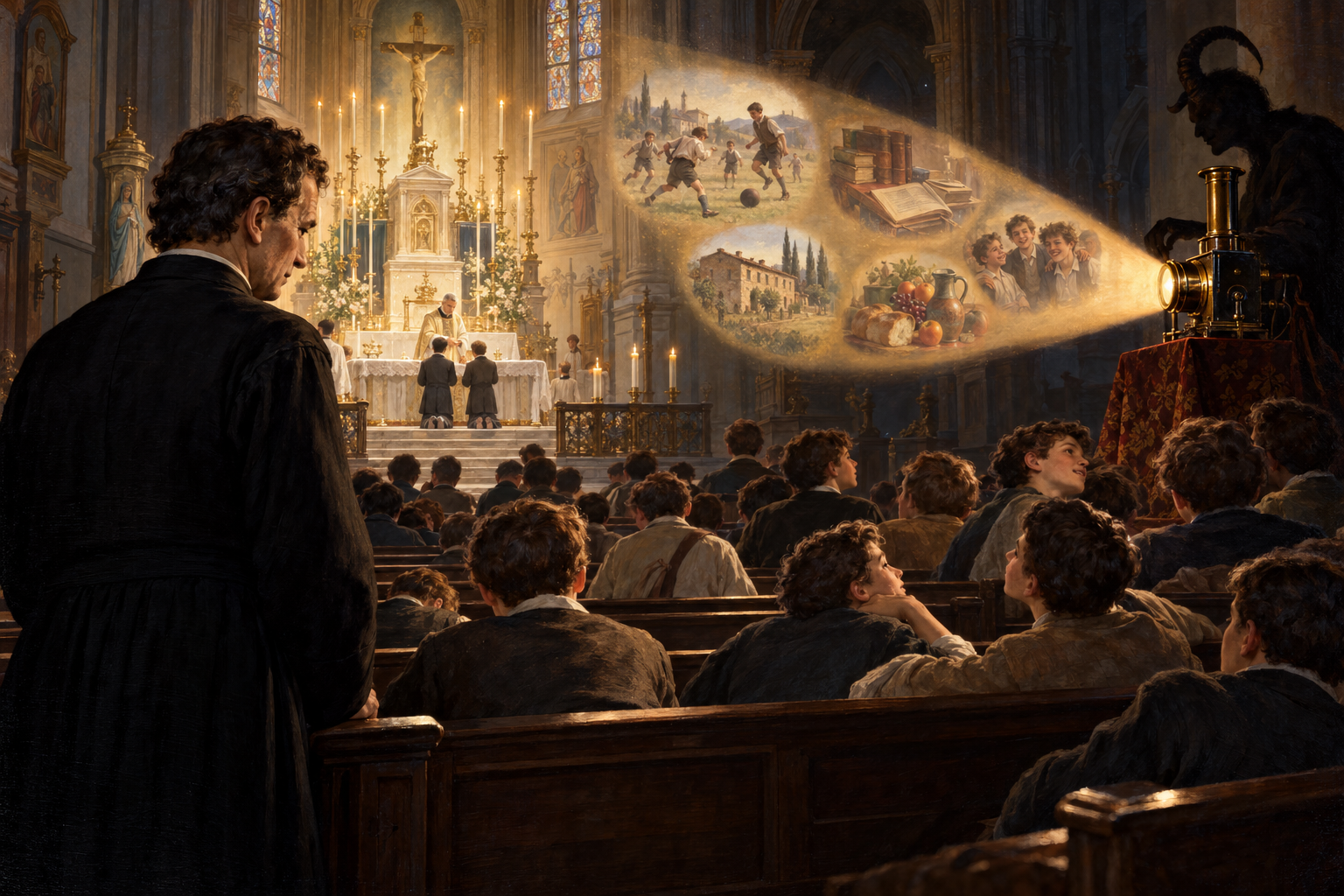
Reading St John Bosco’s dream, I find myself wondering where I would be in that church.
Would I be among the few approaching Holy Communion? Or would there be something in the lantern’s light that held my attention long enough for me to forget why I was there?
I would like to think I know the answer. But the dream makes me hesitate.
The magic lantern
On 1 May 1865, Don Bosco described a dream in which he found himself in a church filled with young people. Very few were approaching Holy Communion.
Near the altar stood a dark figure with horns, holding a magic lantern, an early kind of image projector. Through it, the figure showed the young people whatever would capture their attention: games, victories and defeats, places from home, studies, food, friends, and sinful things.
Each person had something to look at. Something that interested them enough to draw their attention away from what was happening before them.
Don Bosco understood the figure to be the devil, working to distract the young people in church and draw them away from the sacraments. His response was a call to break the devil’s lantern.
The account is recorded in the Biographical Memoirs of Don Bosco, Volume VIII, pages 115–116.
It is the ordinary things in that list that make me pause. Food. Friends. Studies. Home. So much of what occupied their attention was familiar, even good.
I wonder what the lantern would show me.
What would hold my attention?
It is difficult to read this dream without thinking about a smartphone. Don Bosco did not explicitly predict one; that connection is a modern interpretation. I don’t need to turn the dream into a prediction to find its question uncomfortable.
What could keep me so interested that I would stop attending to God?
Perhaps something I want to understand. A conversation I want to follow. A problem I feel I should solve immediately. Something that looks useful enough to justify giving it another few minutes.
The thought that troubles me is how easily I could find a reason for each of those things.
There is always more to read, more to respond to, more to finish. If I wait until nothing else asks for my attention, when will I pray?
What place am I leaving for God in the attention I give away each day?
That question feels more searching than simply asking how much time I spend on my phone. I could reduce the hours and still fill every quiet moment with something else.
The young people in the dream were already in church. Their bodies were there. Their attention was elsewhere.
I can picture myself among them.
Being there
I want to be careful with that thought. A wandering mind in prayer is part of being human. Distraction does not mean that I have stopped loving God, and perfect concentration cannot be the condition for coming to Him.
But I also don’t want to use that as a reason to avoid examining my habits.
What am I bringing into the silence? What have I been feeding my mind before asking it to become still? Am I willing to let a message wait, or does the possibility of something new feel more urgent than the prayer I have begun?
Even the desire to read something about God can leave me with a question: have I made time to speak to Him?
A reflection can help me pray. So can Scripture on a screen. But I want to notice whether I actually stop and respond, or simply move on to the next thing.
Writing this makes that question especially close. I can spend time finding words about giving God my attention. What will I do when I finish?
Putting it down
Don Bosco’s call to break the lantern leaves me wondering what a small, honest response could look like in my own life.
Perhaps it begins with leaving the phone in another room for a few minutes of prayer. Putting it away before Mass, with enough time to settle. Letting an unanswered question remain unanswered for a little while.
I don’t want to make a grand promise here. I want to consider whether I am willing to do something simple when there is no particular feeling to reward it.
Could I stay in the silence a little longer? When my mind wanders, could I return to God without becoming frustrated with myself? Could I let something interesting pass because I have chosen to be present to Him?
There is a gentleness in that possibility. I can begin again. I can put something down. I can ask for help with the attention I find so difficult to give.
The image that stays with me is that church, with its young people absorbed in everything the lantern has to offer.
I find myself looking for my place among them.
And then looking towards the altar.
Lord, what am I so busy looking at that I am missing You?
Source: The dream recounted on 1 May 1865, recorded in the Biographical Memoirs of Don Bosco, Vol. VIII, pp. 115–116. The account above is paraphrased; the application to smartphones is a contemporary reflection. The cover illustration is an artistic interpretation of the dream.
